triauth for OdooOIDC
Let your staff open Odoo with one approval on their own device, and no Odoo passwords.
- Sign-in through
- OpenID Connect bridge
- Available in
- Self-hosted Odoo and Odoo.sh, with the OCA module
- Set up in
- Settings › Integrations › OAuth Providers
About Odoo
Odoo is a suite of business applications: accounting, CRM, sales, inventory, HR, website, and many more, run as one system. Companies use the free Community edition or the paid Enterprise edition, on their own servers, on Odoo.sh, or on Odoo's online service.
Connect Odoo to triauth
Odoo signs people in through the triauth OpenID Connect bridge, with the OpenID Connect module from the Odoo Community Association. Once connected, the login page shows a button with the label you choose. People on your team click it, type their username, and approve on their own device. Nobody keeps an Odoo password, and when someone leaves, removing their identity records at your domain ends their access to Odoo as well.
How it works
Install the module Authentication OpenID Connect (
auth_oidc) from the OCA server-auth repository into your Odoo, the way you install any community module. It needs the Python packagepython-joseon the server.Open oidc.triauth.org and enter your domain. Paste Odoo's redirect address,
https://odoo.example.com/auth_oauth/signinwith your own Odoo address in place ofodoo.example.com, and click Connect app. The bridge gives you a client ID and a client secret.In Odoo, open Settings › General Settings › Integrations, turn on OAuth Authentication, click OAuth Providers, and create a provider with the fields below, with your domain in place of
example.com.Field Value Provider name example.comAuth Flow OpenID Connect (authorization code flow) Client ID and Client Secret from the bridge Allowed on Login button label Log in with example.comScope openid email profileAuthorization URL https://oidc.triauth.org/example.com/authorizeToken URL https://oidc.triauth.org/example.com/tokenJWKS URL https://oidc.triauth.org/example.com/jwksUnder Settings › Users › Customer Account, choose Free sign up, or send each person an invitation link instead.
Open the login page and click Log in with example.com.
Checkpoint
Odoo's login page shows Log in with example.com under the password form. Choosing it opens a page from the bridge that asks for the username, and the person's authenticator asks them to approve.
Good to know
- With Free sign up on, everyone with an identity at your domain gets an Odoo user the first time they sign in, with the rights of the default template user. To let only one team in, limit the app to a group when you connect it. Without free sign-up, people join through an invitation link and click the button there.
- Odoo's online service cannot install community modules, so this works on your own server or on Odoo.sh.
- Access rights stay in Odoo. The groups published at your domain are not used.
For the person who connects the app
| Setting | Value |
|---|---|
| Redirect address | https://<your Odoo base URL>/auth_oauth/signin, exactly on the host Odoo is served from |
| Where in Odoo | Settings › General Settings › Integrations › OAuth Providers, after the OCA module is installed |
| Addresses | the three addresses go in one by one, as above, since Odoo does not read the discovery document. The stock OAuth module alone does not work, since it uses the implicit flow |
| Client | Odoo keeps the client secret, so leave This app can't keep a secret unticked when you connect it on the bridge. It also works with the secret left empty, if you tick the box instead |
| End Session URL | leave empty |
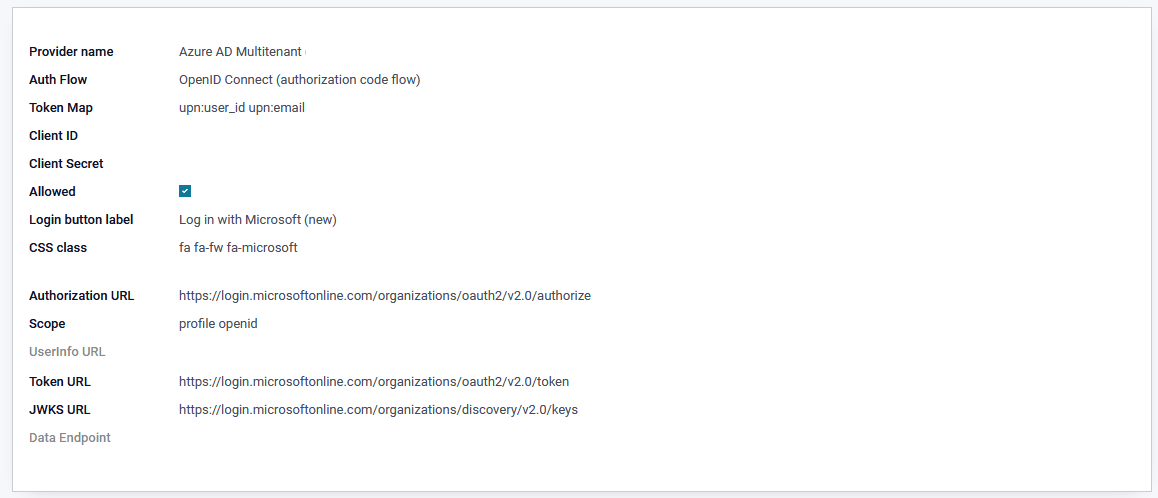
The OCA module's README lists the fields for the authorization code flow, with Keycloak as its example.
Next steps
- Read the OpenID Connect bridge page for what every connected app gets and what the bridge keeps private.
- Read Roll out to your team to give everyone in your organization an identifier at your domain.
- Read Groups to limit Odoo to one team when you connect it.
- Read the OCA module's README for every setting the module offers.
All logos and trademarks belong to their respective owners and do not imply affiliation or endorsement of the organization or product by triauth, nor vice versa. The content provided on this page may include information from third-party sources. We do not assume any responsibility for the completeness, correctness, or applicability of the information. You should independently verify any details before relying on them.